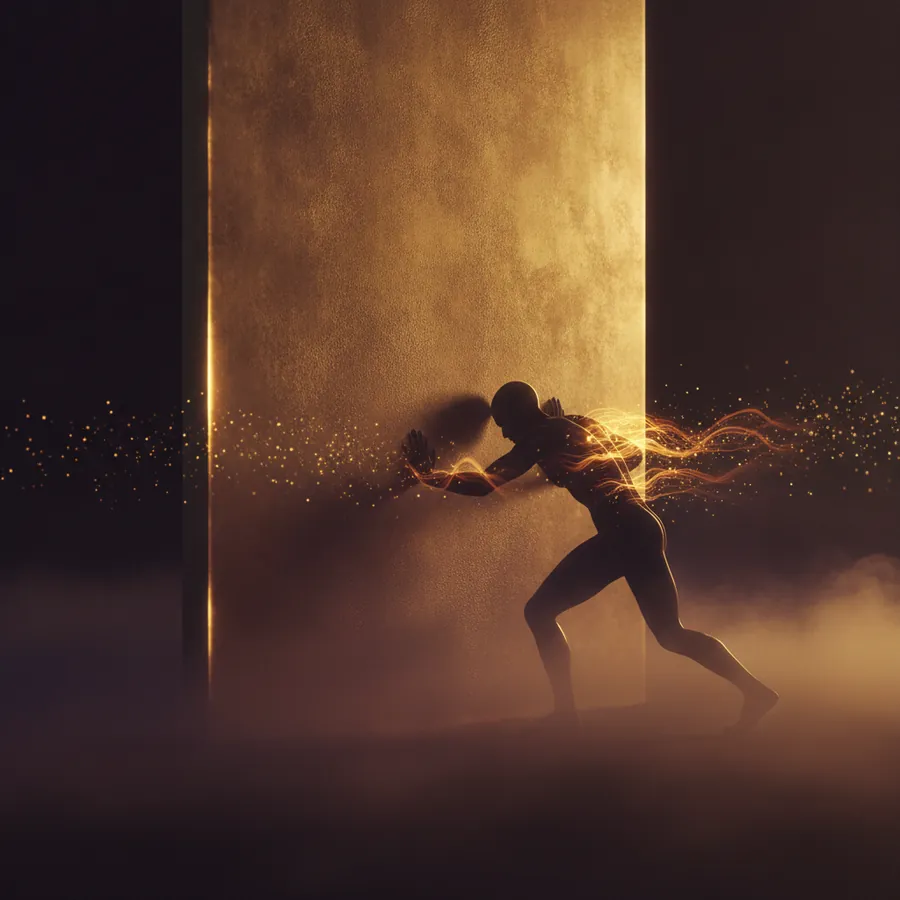
Something sets you off — a comment, an email, a look — and the surge is instant. Heat in the chest, a tightening, the urge to snap or flee. It feels enormous, and it feels like it could last forever. So you do what most people do: you act on it, or you clamp down on it, or you replay it for the rest of the afternoon.
Here's what almost nobody tells you about that surge. The raw, physical part of it — the actual chemistry flooding your body — is brief. It rises, it crests, and it clears in well under two minutes, all on its own, if you let it. What turns a two-minute wave into a two-hour storm isn't the emotion. It's you, feeding it.
The mechanism: the wave has a lifespan
The neuroanatomist Jill Bolte Taylor, writing in My Stroke of Insight, describes the physiological reaction to a triggering event as something that surges through the body and then flushes out remarkably quickly — a wave of roughly ninety seconds. After that, the original chemistry is gone. Anything you still feel beyond that window is being re-triggered by your own thinking: the replay, the how dare they, the rehearsal of what you should have said. You're not still riding the first wave. You're generating new ones, one resentful thought at a time.
This is oddly liberating once you see it. The emotion was never the problem — the emotion is a wave, and waves pass. The problem is the story you narrate while it moves, because the story keeps pressing the trigger. The skill of calm isn't suppressing the wave. It's refusing to manufacture the next one.
The feeling lasts about ninety seconds. The story you tell about it can last all day. Only one of those is the emotion.
Why naming it works when fighting it doesn't
When a feeling is vague and wordless, it owns you — it's just a formless surge of bad, and a formless thing can't be reasoned with. The instinct is to fight it or shove it down. Both fail: fighting a wave only makes more turbulence, and suppression just buries it alive.
There's a better move, and it's almost too simple to trust. Name it. This is anger. This is anxiety. This is the sting of feeling dismissed. The psychiatrist Dan Siegel calls this "name it to tame it," and the reason it works is structural, not motivational: putting a feeling into words shifts your brain's activity away from the raw alarm circuitry and toward the language-and-reasoning regions. You're not arguing with the emotion. You're labeling it — and the labeling itself turns the volume down. You're no longer in the wave; you're the one watching it, narrating it, which means you've already stepped slightly outside it.
The practice: find the space, ride the wave
Between the trigger and your reaction, there's a gap. Viktor Frankl, who survived the camps, called it the last human freedom — the space between what happens to you and what you do next, and the place where all your power lives. The gap is usually about one breath wide. Most of us blow straight through it. The practice is to find it and stand in it long enough for the wave to crest.
- One breath, first. The moment you feel the surge, take a single slow breath before you move, speak, or send. You're not calming down by force — you're buying the wave a few seconds to begin passing.
- Name it, out loud or on paper. "Right now I'm feeling ____." Be specific. Say where it sits in your body. Don't argue with it; just label it and let it be there.
- Let it crest, then decide. Don't act at the peak. The peak is the loudest, dumbest moment to choose anything. Let the wave roll past its crest first — it will — and then respond from the other side of it.
What you get back
The promise here isn't that you'll stop feeling things. A life without anger or fear or grief isn't calm — it's numbness, and you don't want it. The promise is that the feelings stop running you. You get to feel the full wave and still choose your next move from the far side of it, instead of being dragged under at the peak.
That's the whole shift: from the emotion happened, so I reacted to the emotion happened, I let it pass, and then I chose. The wave was always going to come. It was always going to crest in about ninety seconds. The only question was whether you'd spend the next two hours making more of them — or take one breath, name it, and let the water settle.
References
To go deeper into the science and practice of riding emotions:
- Jill Bolte Taylor, My Stroke of Insight — the roughly 90-second physiological lifespan of an emotional reaction, and what keeps it going past that.
- Dan Siegel, Mindsight — "name it to tame it," and why labeling an emotion calms the brain's alarm system.
- Viktor Frankl, Man's Search for Meaning — the space between stimulus and response, and the freedom that lives inside it.
- Kelly McGonigal, The Upside of Stress — how reframing a stress response changes its effect on the body and mind.